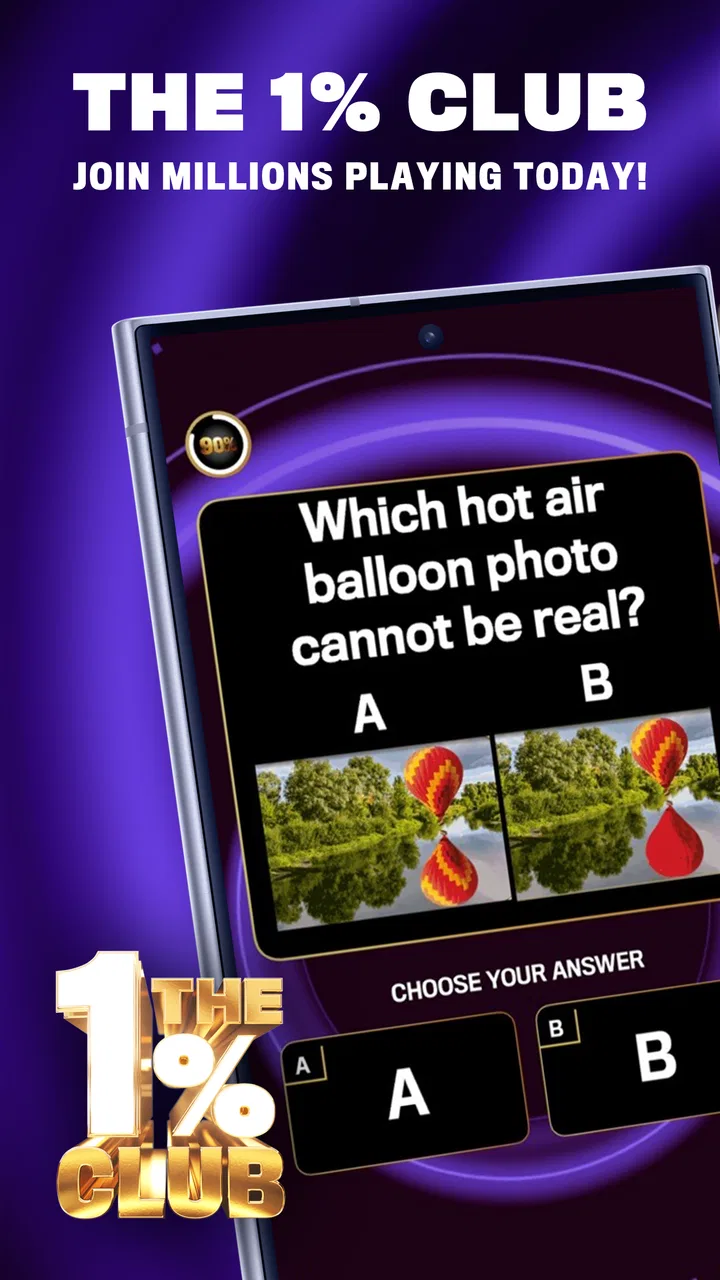
The 1% Club TV Show Quiz Game
- 3.2
- Rating
- 100.00K
- Installs
- Free
- Price

 Analysis by App-foxy
I approached The 1% Club TV Show Quiz Game as a quick trivia challenge rather than a conventional quiz app. Its appeal is easy to understand: it turns television-style questions into a test of reasoning, memory, and general knowledge, with the added pressure of trying to reach the small group of players who can solve the toughest prompts. I found that idea more enjoyable in short sessions than in long ones, especially when I wanted something mentally active without committing to a full game.
The game is free, aimed at Everyone, and comes from Telescope Inc. It sits in the trivia category, but its television-show identity gives it a different feel from a large question bank built around isolated facts. The central attraction is not simply knowing an answer. It is deciding whether I have understood the wording, spotting a pattern, and resisting the temptation to choose the first option that sounds familiar.
That distinction matters when deciding whether it suits you. If you enjoy puzzle-like questions and the tension of a quiz format, there is a good chance you will find it engaging. If you mainly want rapid-fire facts, detailed explanations after every answer, or a highly customizable quiz experience, this may feel more limited. My overall impression is that it works best as a focused, accessible-to-most-people mental break, provided you are comfortable with reading questions and making selections on a mobile screen.
You May Also Like

 Blood Strike: 2.5 Anniversary
Blood Strike’s Loadouts Turn Every Drop Into a Tactical Gamble
A close look at Blood Strike’s custom loadouts: how fast access to signature weapons reshapes its battle royale rhythm, rewards preparation, and narrows the gap between fights.

 Pandora - Music & Podcasts
Pandora’s Music Is Easy to Start, but Harder to Recover
Pandora’s strength is its low-effort path from a seed to a station. Its weak spot is how much confidence it asks you to place in connection, setup, and quiet recovery.

 8 Ball Pool
 Is Built on Rivalries, Rematches, and Routine
A close look at the rivalries, rematches, shared routines, and unanswered safety questions that turn a quick pool match into a persistent mobile community.

 Samsung Music
’s Quiet Strength Is Playing What You Already Own
Its reach comes less from spectacle than from dependable access to a personal library. That simplicity is both the app’s strongest retention engine and its ceiling.

 AccuWeather: Weather Radar
AccuWeather Review: A Quick, Clear Forecast for Everyday Decisions
For everyday plans, the best forecast is the one you can understand quickly. AccuWeather makes rain timing, radar, and local conditions easy to act on, with a few trade-offs.

 Hill Climb Racing
Why Hill Climb Racing Still Turns Crashes Into One More Run
A tiny car, a bumpy hill and one more upgrade: Hill Climb Racing keeps resurfacing because its simple chaos makes every near-miss feel personal.
More From Our News Desk
View All News


How the quiz feels to use in different situations
I find this quiz most useful when I choose the setting to match the kind of attention its questions ask for. A quiet break lets me read carefully, while sharing a prompt with someone else turns the pause before answering into part of the fun. That difference helps explain why the same simple format can feel either relaxing or demanding, depending on where I play.
Readability and navigation during a round
The most important accessibility factor in a text-led trivia game is whether the question can be understood quickly. Here, I paid more attention to wording than decoration. A player may know the subject but still struggle if a sentence is rushed, crowded, or easy to misread. The 1% Club concept naturally rewards careful reading, so I found it useful to pause before answering instead of treating each question like a reflex test.
That creates an interesting trade-off. The game can feel fairer to someone who likes examining language, because success is not limited to memorizing obscure facts. At the same time, players with dyslexia, reduced reading stamina, or a preference for audio-led interaction may find the experience demanding if they need more time to process a question. I would approach each prompt as a small reading exercise: look for qualifiers such as “only,” “always,” or “most,” then compare the possible answers rather than scanning for a familiar word.
Navigation is easiest when I keep the session simple. I do not treat it like a game that needs a complicated setup routine. I open it, settle into the question, and make a choice. That makes it practical for a short break, although anyone who needs unusually large text, stronger contrast, screen-reader guidance, or highly adjustable controls should check the experience on their own device before relying on it regularly. I would not assume that a clean quiz layout automatically meets every individual reading need.
One useful habit is to avoid playing while distracted by another task. In a noisy room, I can still attempt a question because the core interaction is visual, but divided attention makes subtle wording easier to miss. For readers who find dense text tiring, playing fewer questions at a time may be more comfortable than trying to push through a complete session. The game’s strongest accessibility quality is its straightforward premise; its main limitation is that the player still has to extract meaning from the written prompt accurately.
Motor and sensory considerations
Trivia usually has a lower physical demand than an action game, and that is true of this experience in broad terms. I am not required to manage a complicated character, hold a button for long periods, or coordinate several controls at once. The interaction is built around reading, thinking, and selecting, which makes it a reasonable option for players who prefer low-intensity mobile games.
That does not mean every player will find it equally comfortable. Repeated tapping can still be tiring for someone with limited dexterity, tremors, joint pain, or difficulty making precise selections. The practical issue is not speed alone; it is whether the answer area is easy to activate without accidental touches. I found it sensible to hold the phone steadily, use a comfortable grip, and avoid playing one-handed if that makes selection less reliable.
For sensory needs, the game’s trivia format is less visually chaotic than many arcade alternatives. There is no need to follow fast-moving action to understand what is happening. That can make it a calmer choice for someone who becomes overwhelmed by constant motion. However, the mental pressure of a timed or performance-focused quiz can still be stressful, even when the screen itself is not busy. A player sensitive to countdown pressure may enjoy the questions more when treating the result as a personal challenge rather than a judgment of ability.
I also think about hearing access differently here. A quiz can be easier to approach when its essential information is presented in text, because a player does not have to depend entirely on spoken instructions. Still, I would not describe the game as automatically suitable for every deaf or hard-of-hearing player without checking how each screen communicates prompts, feedback, and progression. The safest conclusion is narrower: the basic trivia concept does not require the physical intensity or rapid visual tracking found in many other mobile genres.
Using it at home, on a break, or with other people
The best everyday scenario I found was a short waiting period. I could play while taking a break from work or while waiting for an appointment, then stop after a small number of questions without needing to remember a complex control scheme. That makes it more useful than a lengthy story game when I have only a few spare minutes and still want something more engaging than scrolling through social media.
It can also work as a shared conversation starter. Two people can read a question, discuss the wording, and compare their instincts before selecting an answer. In that setting, the game becomes less about individual performance and more about explaining why an option seems correct. This is particularly helpful for players who enjoy social play but do not want a demanding multiplayer system. The limitation is that a phone screen is still a small shared surface, so group use may become awkward if several people are trying to read at once.
For travel, the low physical demand is convenient. I can imagine using it on a train or in a waiting room, but the environment changes how accessible it feels. Glare, movement, background noise, and a weak grip can all make reading harder. Someone with visual fatigue may prefer a stable indoor setting, while someone who relies on concentration may find public spaces too distracting. In other words, the game travels well in principle, but the quality of the session depends heavily on the surroundings.
It is also a reasonable choice for a family setting because the content rating is Everyone. That does not guarantee that every question will match every child’s reading level or interests, but it does make the game easier to consider for mixed-age use. I would still play alongside younger users when wording is challenging, not to give away answers but to help separate a knowledge gap from a reading difficulty.
What takes practice, and where the friction remains
The biggest barrier is the assumption that everyone can read and interpret a question at the same pace. A player may understand the subject perfectly yet lose confidence because the wording takes longer to process. In a game built around identifying the people who can answer difficult questions, that distinction is important. A result may reflect reading speed, attention, or comfort with quiz pressure as much as general knowledge.
Another barrier is the lack of a naturally flexible play style for every kind of user. Some people want to pause frequently, enlarge content, listen instead of read, or receive more explanation after an incorrect answer. I would not choose this game expecting it to replace a fully adjustable learning tool. It is better understood as entertainment with a reasoning element, not as a structured educational product designed around different learning profiles.
There is also a social-emotional consideration. Competitive quiz framing can be motivating for one person and discouraging for another. If I answer incorrectly, I can either treat it as a funny surprise or feel that the game has exposed a weakness. I recommend deciding beforehand what kind of experience you want. Play it as a light challenge when relaxing; do not use a single result as a measure of intelligence. That mindset makes the hardest questions more enjoyable and reduces the pressure to answer before thinking.
Device settings can make a meaningful difference. Before starting, I would adjust the phone’s display size, brightness, and text-related options to whatever is comfortable, then test whether the question and answer choices remain easy to distinguish. Those changes are not special features of the game, but they are practical ways to improve the experience. A stable connection and a quiet place may also matter more than expected when a question depends on careful reading.
The game is available from Android version 6.0 onward, and the current release is 2.0.0. That broad device compatibility makes it approachable for people who do not own a recent phone, although compatibility by itself does not tell me how comfortable the interface will be on every screen size. On an older or smaller device, I would pay particular attention to legibility and touch accuracy before deciding whether it is suitable for frequent play.
How it compares with ordinary trivia alternatives
Compared with a general knowledge app that throws out a continuous stream of short facts, this game feels more like a television challenge. The difference is useful: I am encouraged to interpret the question rather than simply recall a capital city, date, or celebrity name. That makes it a better fit for people who enjoy reasoning and discussion, while a traditional fact quiz may be better for someone who wants quick repetition and broad subject coverage.
Compared with a puzzle game, it offers less of the tactile satisfaction that comes from moving pieces or building a solution on screen. The challenge is mainly mental and verbal. Players who need strong visual interaction for motivation may find it plain, whereas people who prefer a clean question-and-answer format may appreciate the reduced physical complexity.
It also differs from a formal learning app. I would not use it as a dependable revision system because the experience is designed around entertainment and challenge rather than a personal study plan. If my goal were to improve vocabulary, prepare for an exam, or track progress by topic, I would choose a dedicated learning tool. If my goal were to test myself casually and share surprising questions with friends, this is the more natural choice.
The public response suggests a mixed reception, with an average rating of 3.1 from around 225 ratings and roughly 109 written reviews. I read that as a reason to keep expectations measured rather than as an automatic warning. The game has attracted more than 100 thousand installs, so it is not an obscure experiment, but popularity does not remove the need to decide whether its reading demands and quiz style suit you.
Who should try it and who should skip it
I would recommend trying it if you enjoy television quiz formats, like questions that reward careful interpretation, and want a free game for short sessions. It is especially suitable for someone who prefers low-intensity interaction and does not need a large progression system to stay interested. It can also work well for a pair of friends or family members who enjoy debating an answer before committing to it.
I would be more cautious if you need spoken content, extensive text customization, very forgiving timing, or detailed explanations for learning purposes. Players with significant visual, motor, cognitive, or hearing-related requirements should evaluate the actual screens on their own device instead of assuming that an Everyone rating means universal accessibility. The rating describes the intended age audience, not every person’s ability to use the interface comfortably.
I would also skip it if I wanted a deep competitive ecosystem or a game built around constant novelty. Its attraction comes from the question format and the feeling of taking on a difficult television-style test. Once that format stops being enjoyable, there may not be enough variety in the surrounding experience to compensate. That is not a flaw for a focused trivia game, but it is an important expectation to set before installing it.
My inclusive verdict after playing
My view is that The 1% Club TV Show Quiz Game is approachable in concept and relatively gentle in physical demands, but its accessibility depends strongly on reading comfort, visual clarity, attention, and tolerance for quiz pressure. I like that I can pick it up for a short mental challenge without learning a complicated control system. I also value the way a question can lead to conversation instead of ending with a simple fact check.
Its inclusive strength is simplicity, not deep customization. That makes it a sensible free option for many players, including families and people who prefer calmer trivia over fast action. Its remaining weakness is that the core challenge can blur together knowledge, reading speed, and confidence under pressure. A player who needs more control over presentation or pacing may be better served by a dedicated accessible quiz or learning app.
With that qualification, I would recommend giving it a try if the television-quiz idea appeals to you. The developer is Telescope Inc., the game is free, and its Everyone rating makes it easy to consider for a broad audience. I would begin in a comfortable setting, enlarge the phone’s display if needed, and treat the questions as playful reasoning exercises rather than a test of personal worth. For me, its best quality is the way it turns careful reading into a shared, low-pressure challenge.
FAQs for The 1% Club TV Show Quiz Game
01What is The 1% Club TV Show Quiz Game about?
The 1% Club TV Show Quiz Game is an engaging trivia app inspired by the popular TV show. It challenges players with a series of questions designed to test their general knowledge and logical reasoning. The goal is to progress through levels and join the elite 1% by answering a variety of thought-provoking questions.
02Is The 1% Club TV Show Quiz Game free to play?
Yes, The 1% Club TV Show Quiz Game is free to download and play. However, it may offer in-app purchases or advertisements to enhance the gaming experience. Players can choose to buy hints or additional features to assist them in progressing through the levels.
03What types of questions are featured in the game?
The game features a diverse range of questions covering various topics including science, history, pop culture, and logic puzzles. Each question is designed to challenge your thinking and problem-solving skills, allowing players to test their knowledge across multiple disciplines.
04Are there any multiplayer features in the game?
Yes, The 1% Club TV Show Quiz Game includes multiplayer features that allow players to compete against friends or other players worldwide. This adds a competitive edge to the game, as you can challenge others and see how you rank in comparison to the global leaderboard.
05What platforms is The 1% Club TV Show Quiz Game available on?
The game is available on both Android and iOS platforms. You can download it from the Google Play Store or the Apple App Store. It is optimized for a variety of devices, ensuring a smooth and enjoyable gameplay experience regardless of whether you're using a smartphone or tablet.
Pros
- Engaging questions keep players hooked.
- Intuitive interface for easy navigation.
- Compete with friends for added fun.
- Frequent updates with new content.
- Encourages critical thinking skills.
Cons
- Requires constant internet connection.
- Limited free content without in-app purchases.
- Ads can be intrusive at times.
- Occasional bugs disrupt gameplay.
- Some questions can be repetitive.

The 1% Club TV Show Quiz Game
Gallery